Minimal Residual Disease (MRD) Testing Explained | Dr. Rahul Bhargava
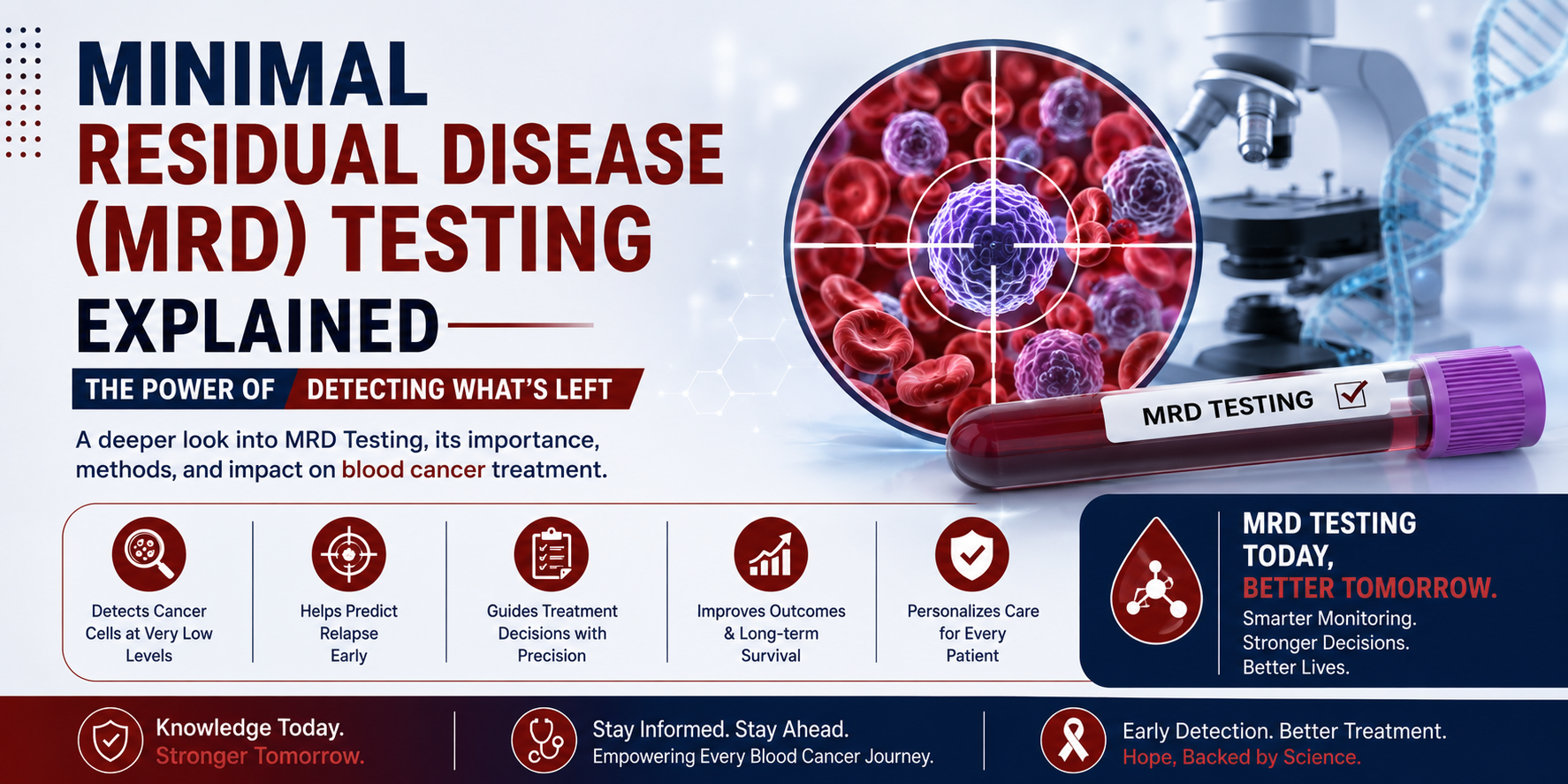
Table of Contents
When a patient hears the words "your cancer is in remission," it often brings a sense of relief. However, remission does not always mean that all cancer cells have disappeared. Sometimes, a very small number of cancer cells can remain hidden in the body. These cells may be too few to be detected by conventional blood tests or by microscopy, but they can eventually grow and cause the disease to return.
This is where Minimal Residual Disease (MRD) testing becomes crucial. MRD testing has revolutionized the way doctors monitor blood cancers by detecting even tiny amounts of remaining disease. It helps specialists understand how well treatment is working, predict the risk of relapse, and make more personalized treatment decisions.
As one of India's leading hematologists and bone marrow transplant specialists, Dr. Rahul Bhargava utilizes advanced diagnostic tools, including MRD testing, to provide patients with precise, evidence-based care for blood cancers.
What is Minimal Residual Disease (MRD)?
Minimal Residual Disease (MRD), also known as Measurable Residual Disease, refers to the small number of cancer cells that may remain in the body after treatment. Although these cells are not detectable by routine laboratory tests, highly sensitive technologies can detect a single cancer cell among hundreds of thousands or even millions of healthy cells.
An MRD-negative result typically indicates that no detectable cancer cells were found using the testing method employed. In contrast, an MRD-positive result means that residual cancer cells are still present.
It's important to understand that:
- An MRD-negative result does not always mean the patient is permanently cured.
- An MRD-positive result does not necessarily indicate that treatment has failed.
Instead, MRD provides valuable information about the effectiveness of therapy and helps guide future treatment planning.
Why is MRD Testing Important?
Blood cancers behave differently from many solid tumors. Even after successful chemotherapy or targeted therapy, microscopic cancer cells may survive and later multiply, leading to relapse.
Minimal Residual Disease (MRD) testing helps doctors in several ways:
- Evaluating the effectiveness of treatment
- Detecting early signs of relapse
- Assessing the depth of remission
- Deciding whether additional treatment is necessary
- Determining eligibility for stem cell transplantation
- Monitoring patients after a bone marrow transplant
- Personalizing future treatment plans
This approach enables doctors to tailor treatment to each patient's disease status, rather than relying solely on standard treatment schedules.
Which Blood Cancers Use MRD Testing?
MRD testing is widely used in several hematological malignancies.
Acute Lymphoblastic Leukemia (ALL)
MRD testing has become a standard part of ALL treatment.
Patients who become MRD-negative after induction chemotherapy generally have significantly better outcomes compared to patients who remain MRD-positive.
Doctors frequently use MRD results to decide whether:
- Additional chemotherapy is needed
- Immunotherapy should be considered
- Bone marrow transplantation is recommended
Acute Myeloid Leukemia (AML)
MRD testing in AML helps identify patients who have a higher risk of relapse.
Because AML can return quickly, early identification of residual disease allows doctors to intervene before symptoms develop.
Multiple Myeloma
In multiple myeloma, MRD testing measures the depth of response after:
- Chemotherapy
- Targeted therapy
- Stem cell transplantation
Patients achieving MRD negativity often experience longer progression-free survival.
Chronic Lymphocytic Leukemia (CLL)
Modern targeted therapies have made MRD testing increasingly important in CLL.
MRD results help determine whether treatment can safely be stopped or should continue.
Certain Types of Lymphoma
MRD testing may also be used in selected lymphoma cases, depending on the disease subtype and treatment protocol.
How is MRD Testing Performed?
MRD (Minimal Residual Disease) testing requires specialized laboratory techniques. The most commonly used methods include:
1. Flow Cytometry
Flow cytometry identifies abnormal cancer cells by analyzing the proteins present on their surfaces.
Advantages:
- Fast results
- Highly sensitive
- Widely available
- Effective in detecting leukemia and myeloma
Sensitivity:
Approximately 1 cancer cell in 10,000 to 100,000 normal cells.
2. Polymerase Chain Reaction (PCR)
PCR detects unique genetic changes found in cancer cells.
Advantages:
- Extremely sensitive
- Highly accurate
- Useful for specific subtypes of leukemia
Sensitivity:
Can detect 1 cancer cell among 100,000 to 1 million healthy cells.
3. Next-Generation Sequencing (NGS)
NGS is one of the most advanced MRD technologies available today. It examines DNA sequences to detect tiny amounts of residual cancer.
Advantages:
- Very high sensitivity
- Excellent accuracy
- Capable of detecting extremely low disease burdens
- Useful for long-term monitoring
Sensitivity:
Up to 1 cancer cell in 1 million normal cells.
Bone Marrow vs Blood Samples
MRD testing may require:
Bone Marrow Aspirate
This remains the preferred sample for many leukemias because cancer cells are primarily found in the bone marrow.
Peripheral Blood
In certain diseases, MRD can also be measured using blood samples, reducing the need for repeated bone marrow procedures.
The choice depends on the specific blood cancer and current treatment stage.
When is MRD Testing Done?
Doctors perform MRD testing at several important stages:
After Initial Chemotherapy
To determine how well treatment has worked.
Before Bone Marrow Transplant
To assess disease burden before transplantation.
After Stem Cell Transplant
To confirm remission and monitor for recurrence.
During Maintenance Therapy
To evaluate ongoing treatment effectiveness.
During Follow-Up
To detect relapse before symptoms appear.
Understanding MRD Results
MRD Negative
This means no detectable cancer cells were identified using the testing method.
Generally associated with:
- Better prognosis
- Lower relapse risk
- Improved long-term survival
MRD Positive
This indicates that small numbers of cancer cells remain.
It may suggest:
- Increased relapse risk
- Need for additional treatment
- Closer monitoring
- Consideration of stem cell transplantation or targeted therapy
Your doctor will always interpret MRD results alongside your overall clinical condition, blood counts, imaging, and other investigations.
Benefits of MRD Testing
MRD testing offers numerous advantages for both patients and physicians.
Personalized Treatment
Treatment decisions become more individualized rather than based only on standard timelines.
Better Risk Assessment
Doctors can identify patients at high risk of relapse much earlier.
Avoiding Overtreatment
Patients with excellent responses may avoid unnecessary intensive therapies.
Early Intervention
Relapse can often be detected before symptoms appear, allowing earlier treatment.
Improved Outcomes
Research consistently shows that MRD-guided treatment strategies improve long-term outcomes in many blood cancers.
Are There Any Limitations?
While MRD testing is highly valuable, it has certain limitations.
- Different cancers require different testing methods.
- Not every patient is eligible for every MRD technique.
- Very small disease levels may still remain below detection limits.
- Results should always be interpreted by experienced hematologists.
- Testing availability may vary depending on laboratory facilities.
Is MRD Testing Painful?
The laboratory test itself is not painful. However, if a bone marrow sample is needed, the procedure involves collecting marrow from the hip bone under local anesthesia. Most patients experience only temporary discomfort, and the procedure is generally well tolerated.
Does MRD Testing Replace Other Investigations?
No. MRD testing complements other diagnostic tools, including:
- Complete blood counts (CBC)
- Bone marrow examination
- Imaging studies
- Molecular testing
- Cytogenetic analysis
- Clinical assessment
Together, these investigations provide a comprehensive picture of a patient's disease status.
The Future of MRD Testing
Advancements in molecular diagnostics are making MRD testing even more accurate and accessible.
Emerging technologies are expected to:
- Detect disease at even lower levels
- Guide personalized therapies
- Improve transplant outcomes
- Reduce unnecessary treatment
- Enhance long-term survival rates
MRD testing is becoming an integral part of precision medicine in hematology, helping doctors tailor treatment based on each patient's unique disease biology.
Why Choose Dr. Rahul Bhargava for Blood Cancer Care?
Managing blood cancers involves more than just treating visible disease; it requires careful monitoring of even the smallest traces of cancer to achieve the best possible outcomes.
Dr. Rahul Bhargava is a highly experienced hematologist and bone marrow transplant specialist, with extensive expertise in diagnosing and treating leukemia, lymphoma, multiple myeloma, aplastic anemia, and other complex blood disorders. He incorporates advanced diagnostic tools, such as minimal residual disease (MRD) testing, into his treatment plans. This approach allows him to provide patients with personalized, evidence-based care focused on achieving deep remission and minimizing the risk of relapse.
Patients receive comprehensive support at every stage of their journey—from diagnosis and treatment planning to transplantation, recovery, and long-term follow-up.
Frequently Asked Questions
Not always. Whether MRD testing is recommended depends on the type of blood cancer, treatment received, and current clinical guidelines.
Not necessarily. MRD negativity indicates that no detectable disease is found using the available testing method, but regular follow-up remains essential.